Pages

Monday, 24 March 2014

Sin City and 300

Sin City and 300

The film industry has defiantly advanced in it's technology over the last 50 years and is still growing to have the best technology to create films.

The has been a huge range of techniques, equipment and sets to create films, and I wanted to talk about a few in this blog, and they are - 

  • Digital Blackbot
  • Neo Noir Atmosphere
  • Superimposition and
  • Chroma Key
I want to talk about two films in particular that use these elements such as "300" and "Sin City"

Now "Sin City" has the Neo Noir/Film Noir atmosphere style which has been around for many years since the 1940's. But now has been updated and uses modern technology to create it, such as a Digital blacklot set by using H-D digital cameras and actors working on a green/blue screen set to create artificial backgrounds, which are then added in Post-production.

"Sin City" is one of the Few fully digital, live-action films to be created including the film "Sky Captain and the World of Tomorrow".

Facts about "Sin City's" colourisation in the film is that the entire film was shot in full colour and was converted to black and white. Sections of the film that did have colour, including clothing of the characters were colour-corrected digitally, which meant they had to heighten the contrast to show the clear deferences from the black and white.
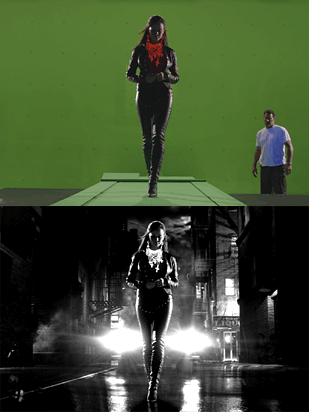

This technique was also used in "300"


"300" also used other techniques such as Superimposition and Chroma key.

Superimposition - definition, "to print an image over another image so that both are seen at once", to give the image an overall effect or to conceal something in the image. the effect can be done using 2-D and 3-D images.

Another technique used in Chroma key which is a special effects/post-production technique
"compositing (layering) two images or video-streams together based on colour hues" (chroma range)." The technique is used to remove the background from the image/video/object, Or to create a a transparent top layer where a colour range is used to reveal another image behind it.

Chroma Key is also known as colour keying or colour-separation overlay or green/blue screen. Green/blue screens are the most effective in this technique because they differ in the hue from some human skin colours.

Chroma key can be created in software such as, Adobe After Effects, Final Cut Pro, Autodesk Smoke etc. 

There are also other films that use these techniques, equipment and sets - 

  • "Sky Captain and the World of Tomorrow"
  • "Spy Kids" franchise
  • "Speed Racer"
  • "Avatar"
  • "Alice in Wonderland"
References
http://en.wikipedia.org/wiki/Sin_City_(film)#Proof_of_concept
http://en.wikipedia.org/wiki/Film_noir#2000s
http://en.wikipedia.org/wiki/Digital_backlot
http://en.wikipedia.org/wiki/Superimposition
http://dictionary.reference.com/browse/superimpose
http://en.wikipedia.org/wiki/Chroma_key
http://en.wikipedia.org/wiki/300_(film)#Reception

Tuesday, 18 March 2014

Sherlock, Opening Sequence

Sherlock, Opening Theme.

Sherlock is one of the biggest TV series in Europe and in the USA and has won a numerous amount of BAFTA'S and Critic's Television Choice Awards.

https://www.youtube.com/watch?v=ApNy2RWzLXA

I wanted to see how the opening credits were created.

According to websites "Quora" and Wikipedia" the opening credits of Sherlock with shots of London were actually a miniature version of London, and to help it look like a real version of London a technique called Tilt-Shift Photography is used."It can be done with a camera that is capable of tilting and shifting, or even in post production by using digital image processing tools like Photoshop"

http://www.quora.com/Sherlock-TV-series/What-are-some-unique-visual-techniques-used-in-Sherlock-the-BBC-TV-Series

http://en.wikipedia.org/wiki/Miniature_faking#In_popular_culture

You can also see that a range of shots from the episodes were taken from the series and overlapped in certain sections, to create a montage opening sequence. Effects like this can be done in After Effects and also editing software like Premiere Pro and Avid.


Monday, 17 March 2014

Talking Heads, Replica Documentry

Talking Heads, Replica Documentary

I really enjoyed doing this challenge, one because we had a small amount of time to complete it, which was three days even while we had other tutorials and projects we were doing at the time. Also it meant we all had to pull together to create this video.

We were originally in small groups, but had the idea of working together as one group so we could assign people to certain ages groups.

The video is a representation of Kristoph Kieslowsk's Talking Heads documentry

https://vimeo.com/88444112

Friday, 14 March 2014

Editing: Analysis


Editing: Analysis

One of the Tutorials this week was based on analysis. Analysing editing in TV, Film, adverts etc.

This lesson was to help improve our ability and skills on how we looked at certain clips, through, pace, structure, flow, cuts etc.  We looked at a number of clips - 


A clip from "In The Mood for Love" - https://www.youtube.com/watch?v=EjcTPRkAfL0

A fight scene from "300" - https://www.youtube.com/watch?v=HdNn5TZu6R8

The forest scene from "Sherlock Holmes 2, A Game Of Shadows" - https://www.youtube.com/watch?v=0QR1LGJyTdE 

The clip from "In the Mood for Love" had good pace with the music, and sometimes went in time with the actor's body movements. It also used slow motion to create a feeling of loneliness for both characters and a small sense of interaction when they talk to other minor characters.
There is also a feeling of being lost in your thoughts mainly in sections when the characters are doing small movements (0.31 and 1.13 for the woman and 1.57 for the man). There is one section towards the end where the pace of the clip goes back to normal like everything has been forgotten about.

One of the fight scenes from "300"  also has changes of pace,  and can be seen between the sections of the two enemies advancing on each other. The Persian Army have an effect of slow motion to show the multiple soldiers they have compared to the Spartan Army and shocking moment for an audiences reaction. A normal pace is used for the Spartan Army as they prepare to fight, which can show there aggression and also shows a difference between the two armies. Another good use of editing,  when a Persian leader gets hit with a spear. It's good because you don't know it is coming, and with the use of Mid-shots and Over-the Shoulder shots of the army and also Close-ups of the Persian leaders face, it distracts the audience from the battle and keeps them focused on the Persian leader.

The Forest scene from "Sherlock Holmes, Game of Shadows" is one of my favourites from this film. It has that same style as the first film which I'm glad they kept, through the use of ranges of pace and slow motion.
One good change of pace is used towards the beginning of the scene, to show the destination of where the characters are headed. This shot keeps the characteristics of the film, but also pin points where there going, like on a map. One brilliant edited section, where the characters are running through the forest shows the characters situation and the amount of danger there in. For example the slow motion shot where a bullet fly's past Dr Watson or where a bullet hits the section of a tree and there's detail of the tree's splinters flying towards the screen. For me this was definitely and hold your breath moment. 
The music 24 seconds into the scene has a idea that something is about to happen as it gets louder and the characters see where they can go the escape. This really helps the show that another section is about to happen and more action is about to take place.


Wednesday, 5 March 2014

Sherlock, Mind Palace Editing

Sherlock, Mind Palace Editing

Sherlock one of the most popular TV series in the world uses a range of camera and editing effects.


One effect used is Motion Tracking.  According to the website "Quora" these techniques could have been done by using "Subtle motion tracking markers" and "a composting tool like After Effects" to track the markers to "create a movement path which corresponds to the movement of the marker on the screen."


http://www.quora.com/Sherlock-TV-series/What-are-some-unique-visual-techniques-used-in-Sherlock-the-BBC-TV-Series


This effect has been used in nearly every episode including "The Hounds of Baskerville", A Scandal in Belgravia and "The Sign of Three".


There is also another technique used called The Bullet Time Effect.


This effect was used in the episode "The Sign of Three" to represent the pictures being taken at their wedding.


http://www.youtube.com/watch?v=UyoX-8hl10E


This effect was created by using a number of camera's while everybody stood still as the cameras panned and recorded.


This effect worked surprisingly well to show the happy couples day and it has the effect of a real wedding. with the facial expression of Mary and John, also Mrs Hudson.


Tuesday, 4 March 2014

Adobe Photoshop and After Effects Tutorials

Adobe Photoshop and After Effects Tutorials

Using Photoshop and After Effects can be difficult to use sometimes, because of the range of different things you can create on these programs.

So here is one tutorial, on a technique in After Effects.

Muzzle flash for a gun

Here is a smoke cloud to use


And here are a range of images to use, but any image similar to these can be used :)


Sunday, 23 February 2014

Film Review: Frozen

Film Review: Frozen

A learning point from this film would be to look at the detail of the animation  

This new Disney film has been created with a use of extreme detail in mind.

The characters - the detail for characters would have been spread over all areas, the way they look, costumes, movement in their body and facial expressions and also the way they sound.

The characters of Anna and Elsa have a similarity in facial structure and movement to the character of Rapunzel in Disney's 50th animated feature film "Tangled" but has expanded since then to be more life like. for example in the song "Love Is An Open Door" the movements between Anna and Hans mainly in the shadow section become so life like which in my opinion has it's pro's and con's,

Pro's being the development of Disney's technology and making animation close to life. But the Con's being it shouldn't be too life like because it can ruin the illusion of the story and for some people that might use films such as this for escapism and it could change there opinion of the film.
Setting - The amount of detail used for the setting would be on a wide scale because of the size of each location e.g. the city of Arendelle would have detail of the castle (it's doors, windows, turrets, the walls, inside detail, of the paintings, furniture etc.) it's grounds and the surrounding area which changes for both seasons in the film to Summer and Winter.
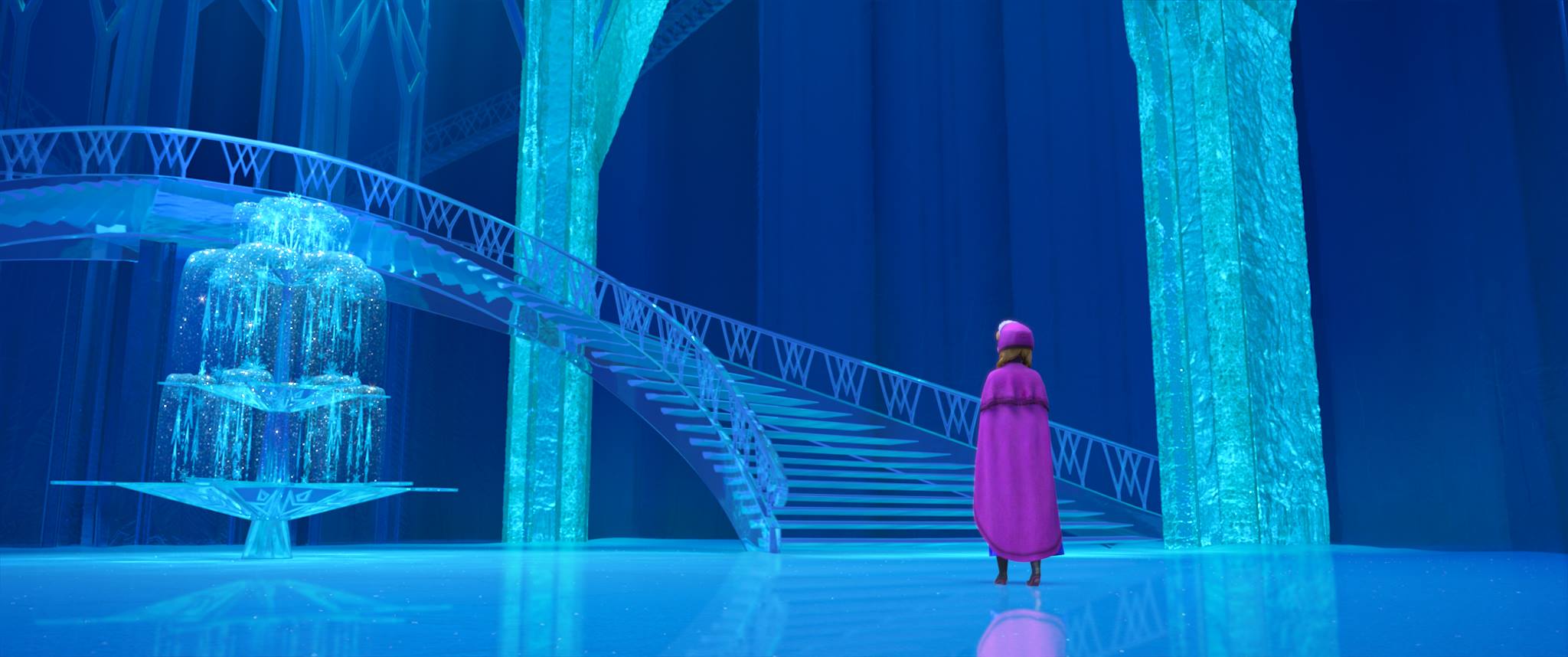
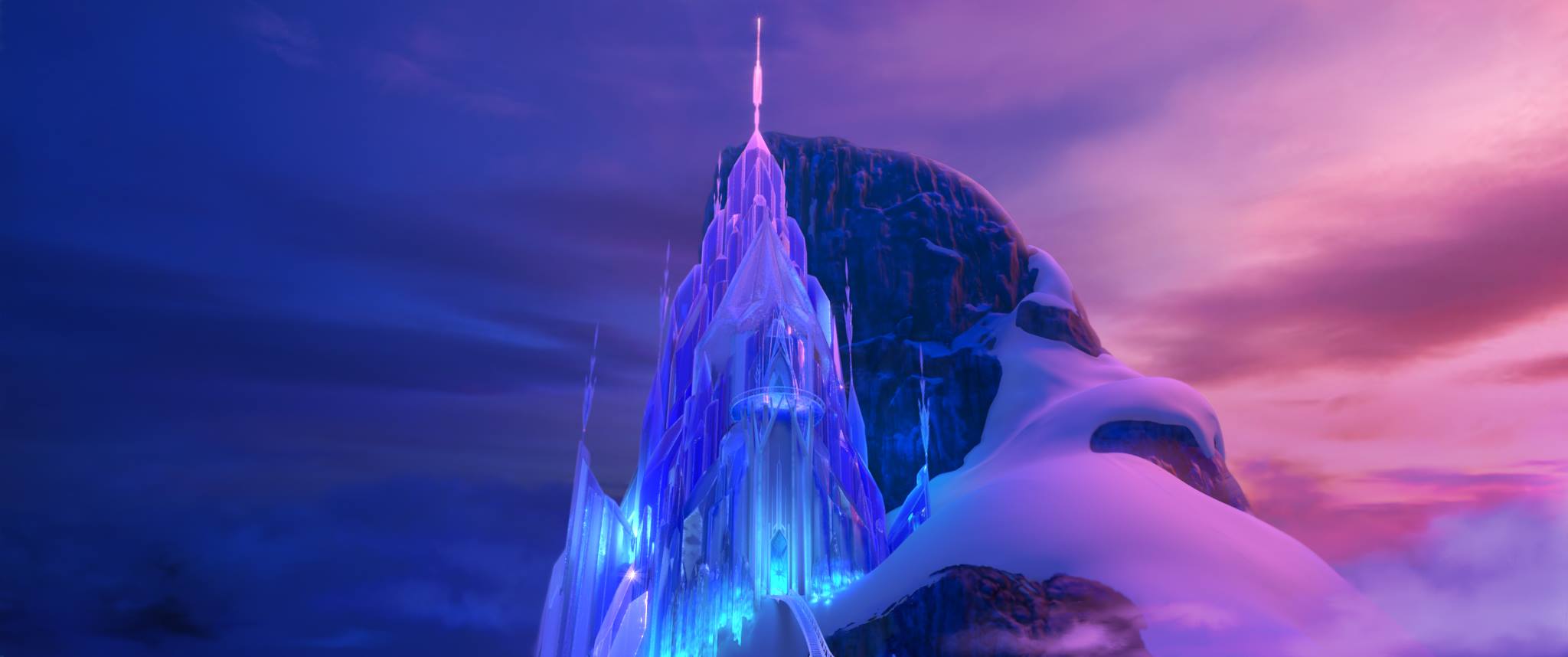
There is also immaculate detail in the castle that Elsa creates mainly as it grows out of the ground and the detail of inside from the ceiling to the floor.
Ice and snow - one of the best sections the show the detail of the ice would be when Elsa reviles her power at her coronation and creates sharp ice sculptures to show her anger and the detail of the frozen fountains which was clean and crisp to have a realistic look.

As a review as an opinion I found the film one of the best Disney animated princess film's for a long time apart from "Tangled". I would say the story line had real emotion towards it and all the characters had there own unique personality. I think everybody can relate to each character and is a brilliant family film which has happiness, humor and sadness all rolled into one.

Frozen won a BAFTA for Best Animated film this year and is nominated for two Oscars in Best Animated Feature and Best Original Song - "Let It Go."